
Industry: EdTech · Online learning marketplace
Engagement: End-to-end re-platform · Ongoing growth and performance engineering
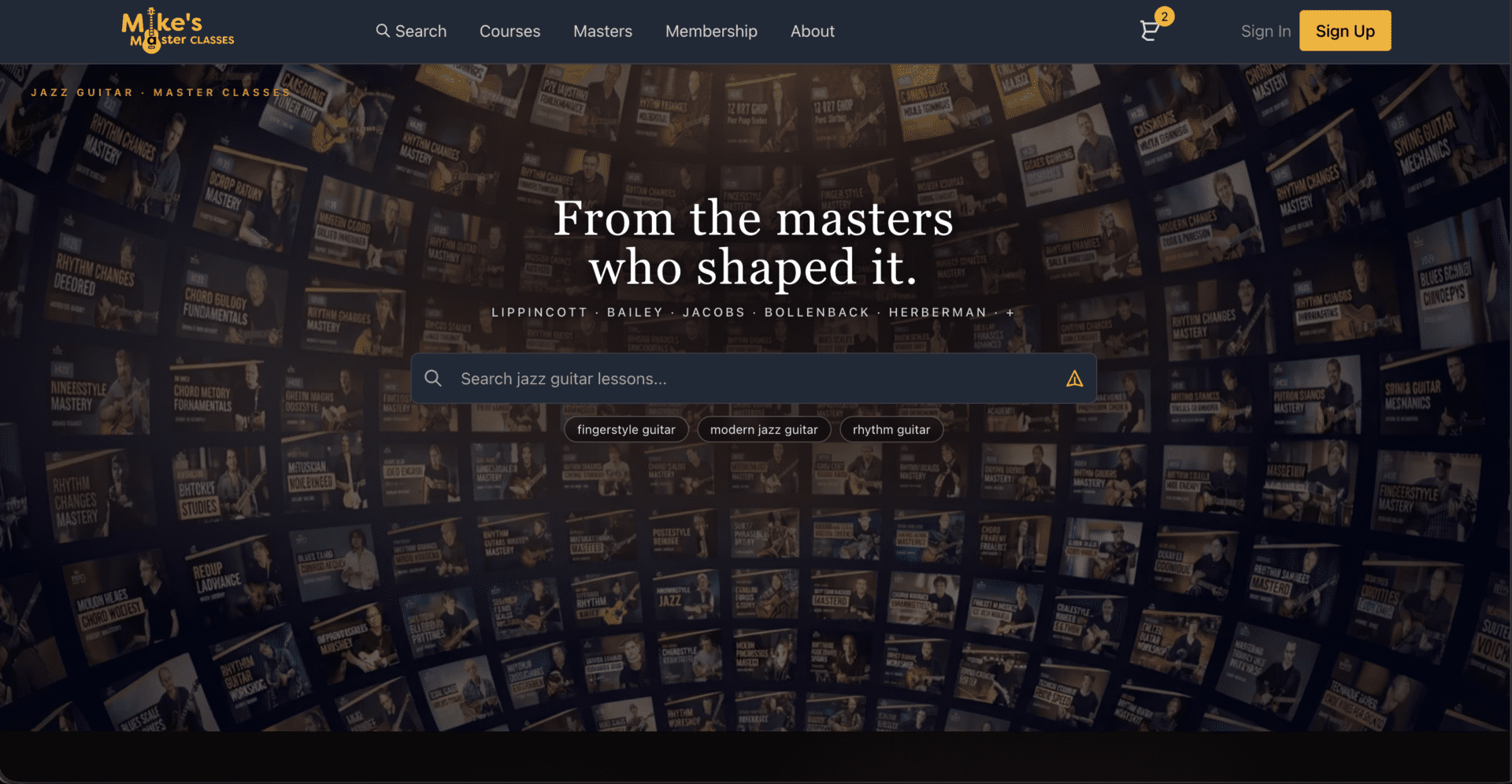
Mike’s Master Classes spent a decade building one of the most respected catalogs in online music education. The business was healthy. The platform underneath it was not. Plugin updates were risky, page speeds were costing them in Google rankings and paid-ad efficiency, and the roadmap their audience deserved — interactive sheet music, intelligent search across video lessons, multiple payment options, instructor credentialing — couldn’t be built on the existing foundation without years of duct tape.
New Blood partnered with Mike’s Master Classes to retire the legacy platform and build, from the ground up, a web application engineered for the next decade of the business. We migrated every student, every order, every review, and every relationship intact — and delivered a platform that today reads to Google like a serious institution, loads like a modern SaaS product, and ships new features at the cadence of the business rather than the cadence of technical debt.
The situation
The legacy WordPress platform had served the business well, but it was beginning to define what the business couldn’t do.
- Search engines were undervaluing the catalog. A site this rich in original instructional content should have been dominating long-tail search. It wasn’t, because the underlying platform wasn’t speaking Google’s modern language.
- Page speed was bleeding money. Slow pages mean lower ad-quality scores, lower organic rankings, and visitors who leave before they convert. The cost wasn’t on a line item, but it was real.
- The roadmap was stuck. Every new feature meant fighting the platform. Every plugin update was a risk to the production site. Founders should be deciding what to build next, not whether they can build next.
- A decade of customer relationships was at stake. Any migration carried the risk of broken logins, lost progress, missing reviews, and dropped SEO rankings. That risk had to go to zero.
The mandate was straightforward and unforgiving: modernize the entire platform without losing a single student, a single record, or a single ranking.
What we built
We delivered a fully modern web application designed around a simple premise: the platform should be a competitive advantage, not a constraint.
A faster site that earns more from every visitor
Every second of page load translates directly into lost conversions and lower search rankings. We engineered the site for the speeds modern audiences expect — and modern search engines reward. Pages render fast on first visit, stay fast as students navigate the catalog, and feel responsive on mobile devices where a meaningful share of the audience lives.
This wasn’t a coat of paint. We re-engineered the way the site loads from the ground up, removing categories of slowdowns most agencies don’t even think to look for. The result is a site that compounds: better speed → better rankings → better paid-ad performance → more students → more reviews → better rankings again.
A site Google actually understands
A music school with this much depth should rank for the questions students are actually asking — specific solos, specific techniques, specific instructors. We rebuilt the site so search engines can read it the way a librarian reads a card catalog: every course, every instructor, every article, every review tagged with the structured information Google uses to decide who deserves to show up first.
We also surfaced instructor credentials — bios, performance history, education, notable work — both for students reading the page and for Google’s quality-signal evaluators. In a category where trust matters and where Google increasingly rewards demonstrable expertise, this turns the instructor roster into an SEO asset rather than just a marketing one.
Interactive sheet music, built in
Most music education platforms either don’t ship interactive notation or ship it badly. We integrated a best-in-class music notation system across a substantial portion of the lesson catalog, with playback synchronized to video and per-student practice tracking so learners see their progress over time. This is the kind of feature students don’t expect from an independent education brand — and once they have it, they don’t want to go back.
Search that actually finds things
Students search the way they think: “the part where he plays the altered chord,” “Charlie Christian solo,” “thumb position.” We deployed a search system indexed not just against course titles but against the full text of video transcripts — so a student looking for a specific concept lands on the exact lesson, not the closest course. This is a meaningfully better experience than what the broader market currently offers in this category.
A real commerce stack
Modern customers expect to pay how they want to pay. We built in support for both card payments and PayPal — with PayPal also functioning as a one-click login option, reducing checkout friction. Instructor commissions are tracked automatically. Subscription credits, gifting, and bundling are all supported as native features rather than fragile bolt-ons.
Email that reaches the inbox
Email deliverability is invisible until it isn’t. We separated the platform’s transactional email (welcome notes, order confirmations, password resets) from its marketing email (campaigns, announcements) — sending each through the channel best suited to it. The practical effect: campaign emails don’t risk the deliverability of important account emails, and important account emails arrive reliably from the founder’s own address, preserving the personal trust the brand has built.
The migration: zero loss, by design
A re-platform is a moment of maximum risk for any established business. We treated it that way.
- Every existing student account moved over with their identity, their purchase history, and their progress through every lesson.
- Every historical order, going back years, was preserved with its original payment details intact for accounting and audit.
- Every review carried over with its rating, its verified-purchase status, and its place in the catalog.
- Every instructor relationship, including historical commissions, was reconstructed in the new system.
The day the new platform went live, no student noticed anything had changed except that the site was faster.
Where we pushed the industry
A few of the engineering decisions on this project deserve a CEO-level mention because they translate directly into business durability.
- We refused to ship a platform that would be slow next year. A common failure mode in modern web apps is that they look fast on launch day and degrade over time as features pile up. We engineered against that pattern from day one, using techniques that prevent the slow-creep performance death that quietly kills conversion rates.
- We built deployment discipline into the workflow. Most platforms eventually have an outage caused by a database change rolled out in the wrong order. We codified the order so that this entire category of failure simply cannot happen on this platform. The CEO never has to learn what it means.
- We made the operations layer automatable. Routine tasks that used to require an engineer — managing email lists, granting course access, sending campaigns, hygiene jobs — are now scripted with safe defaults and dry-run modes. The team gets more done with less engineering involvement.
- We tested against real data, not pretend data. Many platforms pass their tests in development and break in production because the test data didn’t match reality. Our test approach validates the platform against the actual shape of the live business, surfacing problems before customers do.
These aren’t features a customer will ever see. They’re the reason the platform will still be running smoothly in 2030 without a rewrite.
What it means for the business
The platform Mike’s Master Classes runs on today is one where:
- New courses, articles, and instructor pages can be launched as soon as they’re ready.
- New revenue experiments — bundles, gifts, promotions, subscription tiers — can be tested without engineering heroics.
- The site competes for organic traffic on a level that matches the quality of the catalog.
- The founder spends time on the business instead of fighting the platform.
- Every dollar spent on paid acquisition lands on a site engineered to convert it.
The investment isn’t a website. It’s an operating foundation for the next phase of the company.